When you picture a school day for your child, you may be looking for more than a quieter classroom or extra time on an assignment. You may be wondering who will notice when communication feels effortful, how therapy fits into the day, whether your child’s interests will matter, and how you will stay connected to the people teaching them.
At MDE School in Marietta, individualized education is not a document that sits in a file. It is the ongoing practice of knowing your child: how they communicate, what helps them feel regulated, which subjects light them up, and what support helps them participate with confidence. Your child receives an education designed for the way they learn, with academic, therapeutic, social-emotional, and life-skills goals considered together.
As a parent, you deserve to understand what that looks like beyond the basics. Here is a closer look at the planning, teamwork, and daily rhythms that can make an individualized setting feel both structured and deeply personal.
Individualized education begins with knowing your child
Individualized education is sometimes misunderstood as simply working alone or receiving a different worksheet. Your child may certainly receive instruction tailored to their current skills, but meaningful individualization goes much further. It starts with careful observation, family conversation, records review, and a clear picture of your child as a whole person.
At MDE School, the team considers questions such as:
- How does your child best take in information: through visuals, spoken language, movement, hands-on practice, or a combination?
- What conditions help your child feel ready to learn?
- How does your child communicate ideas, preferences, and needs?
- Which interests, talents, and successes can create momentum?
- What academic, social, emotional, and practical skills are most meaningful for this stage of life?
This process creates a living educational plan rather than a one-size-fits-all path. Goals give the team direction, but the plan remains responsive. If your child demonstrates readiness for a new challenge, instruction can expand. If a particular approach is not connecting, educators can adjust the materials, pacing, supports, or setting.
“The most useful plan is one that helps adults see the child in front of them—not just a list of goals. When a child feels understood, we can build from their strengths with purpose and care.” — Mindy Elkan, MA, CCC-SLP
What a personalized school day can look like
A predictable routine can offer your child a sense of safety, while individualized supports make that routine accessible. The exact schedule varies by age and program, but a day at a special needs school can include focused academics, therapy, movement, peer connection, meals, transitions, and opportunities to practice independence.
Arrival and readiness
The day often begins with a warm, consistent check-in. Your child may review a visual schedule, talk through what is ahead, choose a regulating activity, or reconnect with a trusted adult. This is not “extra” time before learning begins. It is part of learning. A child who understands the day and feels supported at the start has a stronger foundation for participating in it.
Academics matched to current learning needs
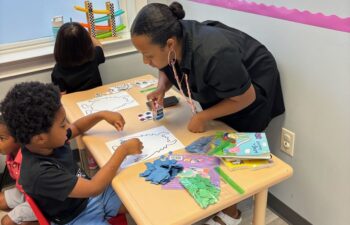
During academic blocks, teachers use small-group and individual instruction to meet learners where they are. One child may be practicing decoding and reading fluency; another may be building comprehension through a high-interest text; another may be learning to organize written ideas with visual supports. In math, your child may use concrete materials, drawings, real-life examples, or technology before moving toward more abstract work.
MDE School educators are specialists, not generalists. The school’s educational approach includes evidence-based methodologies, including MaxScholar training for reading intervention. That expertise matters because your child should not have to fit a pre-set pace before receiving meaningful instruction. A teacher who knows your child can make a lesson appropriately challenging without making it overwhelming.
Therapy that connects to real school moments
When therapy is integrated into the school environment, your child’s speech, occupational therapy, and behavioral therapy supports can connect with the actual situations they navigate each day. Instead of adults working in separate silos, the team can share observations and reinforce helpful strategies across settings.
For example, if your child is working on communicating a need more clearly, a speech-language pathologist may help shape that skill in a therapy session. Their teacher can then create natural chances to use it during group work, lunch, or a classroom choice. If your child benefits from a movement break or a particular way to organize materials, occupational therapy strategies can inform the classroom routine rather than appearing only at one appointment.
That coordination reduces guesswork for your child. The language, visuals, and expectations adults use can feel more consistent from one part of the day to the next.
Social learning and independence in context
Your child’s social-emotional development is not limited to a scheduled lesson. It happens when they join a partner activity, navigate a change in plans, contribute to a class job, ask for a break, or repair a misunderstanding with support. Educators can coach these moments in real time, helping your child practice skills where they matter.
Independence develops the same way: step by step, with dignity. Your child may practice following a schedule, managing belongings, making choices, preparing for transitions, or completing a multistep task. The goal is not to rush independence or measure your child against anyone else. It is to build practical confidence and agency over time.
The adults around your child work as one team
A school can have talented individual professionals, but your child benefits most when those professionals communicate well. At MDE, collaboration is central to individualized education. Teachers, therapists, administrators, and families each hold valuable insight. Your child’s own communication, choices, and preferences belong in that picture, too.
You may hear a teacher share that your child is especially engaged by a particular topic. A therapist may explain a strategy that supports smoother transitions. You may offer the essential home perspective: a new interest, a recent change, a successful routine, or an area that has felt difficult. When that information moves between the people who know your child, it can lead to more thoughtful support.
This is also why credentials and specialized training matter. MDE School was founded by Mindy Elkan, MA, CCC-SLP, an educator and speech-language pathologist with experience serving learners with communication differences in schools, private practice, and clinical settings. Her background shaped a school model that recognizes communication as central to learning, relationships, and self-advocacy.
Today, the team’s work reflects the same commitment: combine educational skill, therapeutic insight, and genuine care. MDE School is accredited by the Georgia Accrediting Commission Inc., adding an important layer of accountability to its educational program.
Strengths are not an afterthought
You may have spent a long time in conversations focused on what your child needs help with. Those needs deserve thoughtful attention. But at MDE School, your child’s strengths are equally important because they reveal how to invite engagement, build confidence, and create meaningful goals.
A deep interest in animals might become the doorway into reading, vocabulary, research, and conversation. A love of building can support math concepts, planning, collaboration, and flexible thinking. A child with a sharp eye for detail may bring an important perspective to science, art, technology, or problem-solving.
Neurodiversity-affirming practice means your child is not treated as a project to be corrected. Their differences are recognized as part of who they are. Adults still provide explicit support, teach new skills, and hold meaningful expectations. The difference is the starting point: respect for your child’s identity, voice, and potential.
How progress becomes visible to your family
Progress is rarely one dramatic moment. More often, it appears in meaningful details: your child walks into school with greater ease, uses a strategy before frustration grows, shares an idea in a group, completes more of a routine independently, or begins to see themselves as someone who can learn.
Clear communication helps you notice and understand those changes. Rather than receiving only broad updates, you deserve conversations that connect goals to your child’s actual school experience. Helpful questions to ask include:
- What is my child working on right now, and why is it a priority?
- What support is helping most during the school day?
- Where are you seeing my child’s strengths show up?
- How are teachers and therapists coordinating around a shared goal?
- What can we reinforce at home without turning home into another school day?
At MDE, family partnership is not an occasional conference topic. You are an essential member of your child’s team. Honest updates, shared problem-solving, and celebrations of growth help create continuity between school and home.
Individualization also means planning for what comes next
Your child’s plan should make sense for today while keeping an eye on tomorrow. For younger learners, that may mean building communication, classroom readiness, early literacy, play, and self-help skills. For older students, planning may include executive-function supports, self-advocacy, life skills, community participation, and preparation for increasing independence.
This long view can be especially reassuring when you are exploring a special needs school in Marietta, GA. You do not need every answer about your child’s future before you choose a setting. You do need a school that can see beyond the immediate concern and help your child develop skills that carry forward.
For some Georgia families, the SB 10 scholarship is part of the practical conversation around educational options. Scholarship requirements and eligibility can change, so it is wise to review current information through the Georgia Department of Education and discuss questions directly with the school. The scholarship process is one piece of the journey; understanding how a school will know and support your child every day is another essential piece.
A place where your child can be known
Choosing an individualized school setting is not about finding a perfect, friction-free experience. It is about finding people who respond thoughtfully when a day is hard, recognize progress that others may miss, and continue to look for the approach that helps your child participate more fully.
Since I founded MDE School in 2009, I have seen the power of a team that refuses to reduce a child to a label or a single score. MDE began with three students and has grown into a community serving more than 100 learners, while holding onto the belief that every child deserves to be genuinely known.
If you are imagining a school day where academics, therapies, relationships, and confidence-building work together, you are asking an important question. Reach out to MDE School to talk about your child, ask about the admissions process, and see whether our community may be the right next step. You do not have to navigate this decision alone. Your child’s potential can find its path in a place built to understand how they learn.
Posted on behalf of
1517 Johnson Ferry Rd Unit 100
Marietta, GA 30062, United States
Phone: (770) 971-4633
Email: [email protected]
Opening Hours
Monday - Friday
9:00 am - 3:00 pm